The Ala Kul Trek: Everything You Need to Know

Updated: 2d
The Ala Kul trek is one of the most popular in Kyrgyzstan, and for good reason. It takes you through forests, alpine meadows, along rivers, and up into the mountains to see the stunning turquoise Ala Kul lake. This guide will tell you everything you need to know before you hike the Ala Kul trek in Kyrgyzstan, including what the trek is like, how to book yurts, what to pack, how to get to the trailhead, how to best prepare, and more advice to make this trek as memorable as possible.

Check out my ultimate 8 day Kyrgyzstan itinerary here!
Contents
How to book Yurts on the Ala Kul Trek
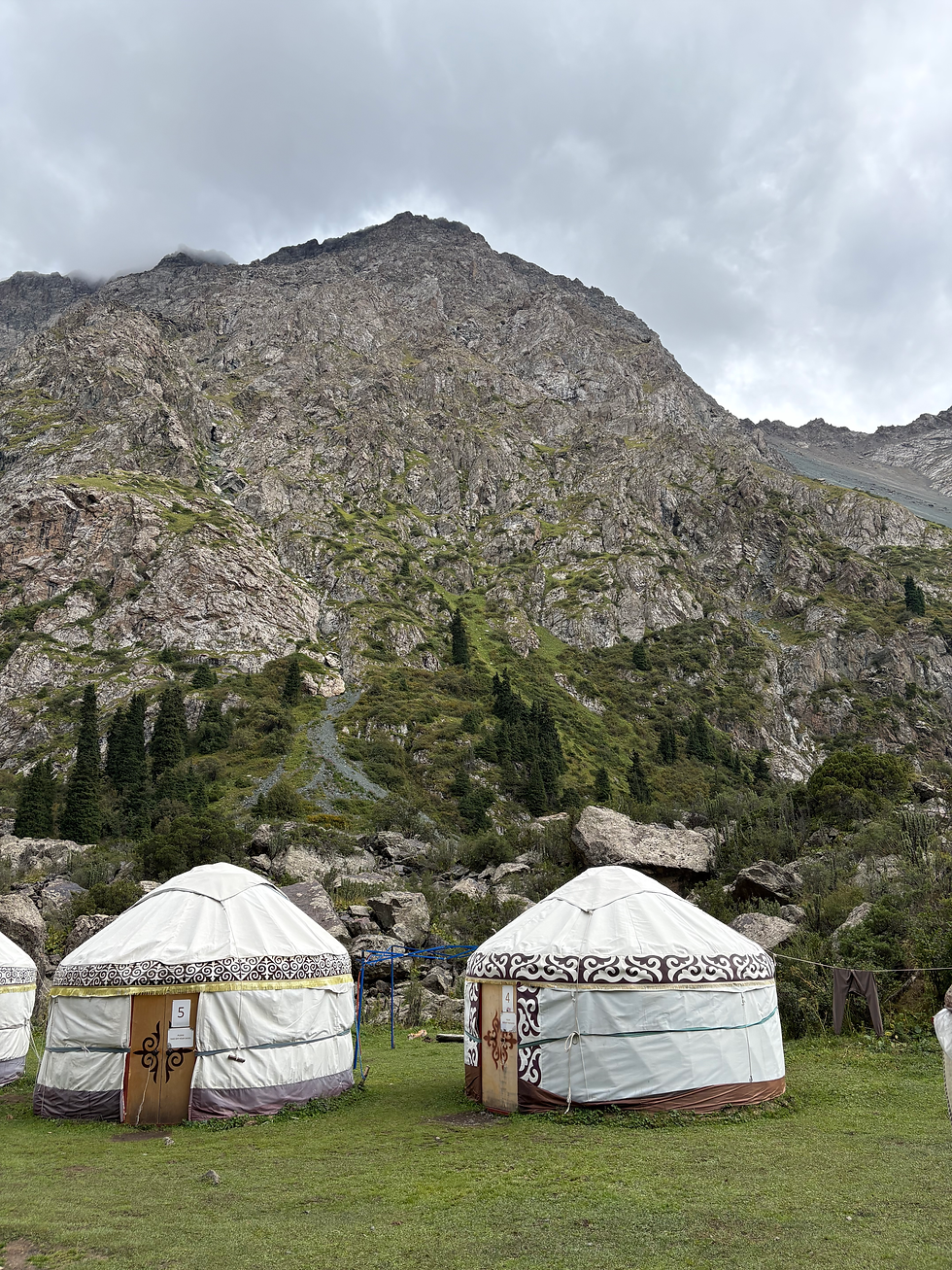
You can either camp in your own tent along the Ala Kul trek, or opt to stay in a traditional Kyrgyz yurt. I chose to stay in yurts as I didn’t want to carry my own camping equipment and cooking gear throughout the three days, and I’m so glad I made this decision. Staying in yurts is also very social, and you’ll meet plenty of people along the way.
I booked my yurts through Duet Hostel in Karakol, which you can do even if you aren’t staying there. They have an agreement with two yurt camps: Sirota Yurt Camp in Sirota, and Bulak Say in Altyn Arashan. I booked this the day before my trek and had no problems. I paid 4500 som (approx. £38) for the yurt in Sirota and 3800 som (approx. £32) for the yurt in Altyn Arashan. It included a night in a shared yurt, dinner, and breakfast. If you are vegetarian or vegan, tell them when you book. You may have to remind them at mealtimes - more on this in the FAQ section!
If you want to book by yourself, you can use Booking.com for this, and if you want to stay in a nicer guesthouse in Altyn Arashan, I would recommend doing this.
I would not recommend just showing up at a yurt camp and assuming they have room, especially during the high season (summer). This trek is one of the most popular in Kyrgyzstan and, while they are building rapidly, the yurts will sell out.
How to get to the trailhead for Ala Kul from Karakol
Most people do the 3 day Ala Kul trek starting from Karakol and ending in Ak Suu. I would strongly recommend this because the inclines on day 2 are much easier this way round.
To get to the Ala Kul trailhead from Karakol, you can either take a taxi to the first bridge or the entrance to the National Park. If you choose just to the entrance to the park, you can get there either by marshrutka (minibus) 101 which leaves regularly when full from Karakol from around 8:30am.
If you want to go earlier, you’ll need to get a taxi or a Yandex to the gate. This cost us about 300 som (approx. £2.50).
Taxiing to the first bridge requires a 4x4 as you will be off road after the National Park entrance. You will need to pre-book a taxi for this, and your accommodation in Karakol can help you do this. It will cost around 2500 som (approx. £21) but saves you 5km of walking/about 2 hours and 150m elevation gain. The walk from the National Park entrance to the first bridge is along a dirt road, but you get great views of the mountains and a feel for rural Kyrgyz life. I really didn’t mind adding this little bit extra!
When you get to the National Park entrance, you’ll need to pay the fee of 300 som (approx £2.50). They take cash and card but the machine does not do change. Keep your receipt throughout the hike!

Ala Kul Day 1: Karakol to Sirota Camp
Distance: 16km
Elevation gain: 700m
Time: 4-5 hours
Day 1 on the Ala Kul trek is a relatively easy one. From the first bridge, you’ll hike up a slow but steady incline to the second bridge. There are some incredible views along the way, including forests, rivers, mountain, waterfalls, and wild horses grazing.
There is a small cafe at a little yurt camp a little before the second bridge, so you can stop there to rest or eat if you want.
After the second bridge, it’s about 3km with 450m of elevation gain to the yurts at Sirota Camp. The views on this section were some of my favourite of the whole trek. Beware that there isn’t a water source on this ascent section, so either fill your bottle or buy some water by the second bridge and the little stalls there to keep you going until Sirota.
Sirota camp is in a beautiful setting, with a river and small lake you can swim in! You’ll get a sneak peak at your ascent for the next morning.

Ala Kul Day 2: Sirota - Ala Kul Lake - Ala Kul Pass - Altyn Arashan
Distance: 19km
Elevation gain: 1150m
Time: 9-10 hours
Breakfast on day 2 starts around 6 or 6:30 and you will want to set off right after that, as this day is long and exhausting.
You will start with 650m of ascent over 3km to Ala Kul lake. It’s a beautiful lake with stunning turquoise water and is surrounded by mountains. I unfortunately had a lot of rain on my day 2, but could still appreciate the beauty of the surroundings.
From the lake, it’s another 700m ascent over 2.5km to Ala Kul pass at 3920m. This bit is gruelling. It’s very cold, the altitude will get to you, and the trail is mostly loose rock, which makes it difficult to walk on. If it’s raining it’s no fun at all. My best recommendation is to have some snacks readily accessible so you can get a sugar rush without having to open up your backpack. You’ll also need lots of water here to help with the altitude. If it’s a clear day, the views from the pass are incredible.
There is a steep drop down from Ala Kul pass to start the 1400m of descent to Altyn Arashan. This first section is very slippery and you’ll be sliding down loose rock and gravel for about 300m of descent. You will probably fall at some point but it’s relatively soft! There’s a yurt camp at the bottom of this section where you can warm up and get tea if you want.

After the yurt camp, it’s a long descent down to Altyn Arashan, and if it’s wet, this section is very muddy, so be prepared for it to be slow. However, the views of the valley as you meet the tree line again are amazing. This whole section is close to the river, so you’ll be able to fill up your water if you need.
There is a river crossing a little way down that does not currently have a bridge. If it’s rainy, the river will be too full to cross by walking on stones, so you have to take shoes off and wade across. Be careful as the water runs fast. If you’re lucky, you might have the option of horses to take you across, but there is no guarantee of this. I was lucky and paid 100 som (approx. £0.85) as the horses showed up right when I did!
There are loads of paths going down to the valley, and none of them are signposted. However, as a general rule, if you’re going down, you’ll find the valley floor at some point. Download Maps.me or AllTrails to help with navigation. It’s steep but very beautiful.
Once you reach the valley floor you need to cross the wooden bridge so you’re walking into Altyn Arashan on the right side of the river. Find your camp or guesthouse and relax! If you want to experience the hotsprings here, you need to book a slot as soon as you get there.

Ala Kul Day 3: Altyn Arashan - Ak Suu
Distance: 16km
Elevation lost: 740m
Time: 4-5 hours
The last day of the Ala Kul trek takes you along the dirt road to Ak Suu. There are gorgeous views of the forest and river the whole way.
If you are too tired, a lot of people opt to take a taxi down to Karakol from Altyn Arashan. This costs 12,000 som (approx. £100) per car, split by the number of people in it. It would by no means be a comfortable ride as the road is very bumpy, and it’ll take you about 2 hours to get to Karakol. I really enjoyed the walk, however, so would recommend that if you can. It’s an easy walk but you’ll be feeling your feet by this point!
To exit the park, you’ll need to pay another fee of 220 som (approx £1.85).

How to get from Ak Suu to Karakol
At Ak Suu, you will reach a V-crossroad where there is a clearly signed bus stop. From here, you can get a marshrutka back to Karakol. There is no timetable and they come pretty sporadically and leave when they’re full. If you don’t want to wait, you can also order a Yandex for about 500-600 som (approx. £5), although it might take a little while to come. Hitchhiking is also a good option - this is what I did and got picked up by the first car who took me straight to my hostel!

What to Pack for the Ala Kul Trek
Alongside your hiking clothes, here is a list of essential things to pack for the Ala Kul trek:
Waterproofs: because you’re in the mountains, the likelihood is you’ll get rain at some point. Make sure your waterproofs are top notch (jacket and trousers), and if you can get waterproof gloves, I would strongly recommend them for the pass. Make sure your backpack also has a good raincover and your hiking boots are waterproof or strongly water resistant at the very least. If you can pack clothes in a dry bag within your backpack, I would recommend this, as it’s much better to be sure your clothes will be dry. Yurts are damp so your clothes won’t really dry overnight, even if it’s just sweat, so make sure you have enough socks, tops, and jumpers for the whole trek.
Water filter and purification tablets. I would recommend bring a bottle with a filter regardless, but especially if it’s rainy because streams can get quite turbid and have a lot of sediment in them. Water purification tablets are a bonus, but I often double purified with my tablet and filter just to be safe! Getting food poisoning on this trek is not something you want to experience.
Lunches: you will need three lunches for the Ala Kul trek. You can buy plenty of food in the supermarkets in Karakol, and they also sell good snacks.
Snacks: don’t hold back! The food that the yurt camps provide on this trek is usually insufficient given the amount of calories you’re burning. I felt like I always needed more snacks.
Hand sanitiser, toilet paper, and wet wipes: showers are non-existent on the Ala Kul trek, as are western toilets. You will need hand sanitiser and toilet paper, and wet wipes to freshen up instead of a shower!
Headtorch: for nights at yurt camps.

Ala Kul Trek FAQs
Where do you get water on the Ala Kul Trek?
As you will be walking along rivers for much of this trek, you will be able to fill up your water bottle for most of the way. The only sections without easy access to a river are between the second bridge and Sirota camp on day 1, between Ala Kul lake and the first steep descent after the Ala Kul pass on day 2, and for the first hour or so on day 3. Make sure you fill up before these sections.
In Altyn Arashan, your camp or guesthouse might not be right next to a river, but there are little shops which sell bottled water if needed, although these cost around 200 som (approx. £1.70) for a litre. Bring a filtered water bottle and water purification tablets.
Do you need a guide for the Ala Kul Trek?
No. Very few people hire a guide for the Ala Kul trek. While the trail is not marked, most of the time it is very straightforward to find your way. Download an offline map like Maps.me or AllTrails in case you need it, but you don’t need a guide to tell you where to go. The yurt camps cook the food, so there is no need for a guide here either.

What is the food like on the Ala Kul Trek?
Your dinners at yurt camps usually consist of a soup with vegetables or rice in it, a plate of fried rice, bread, and some dried fruits, nuts, and sweets. It is nowhere near enough food for the number of calories you will have burned, so make sure you bring snacks.
For breakfast, you’ll normally get eggs, maybe a pancake or some soup, a sausage, bread, jam, and the same dried fruit and nuts. Again, it’s not enough food, so being extra.
Can you be vegetarian or vegan on the Ala Kul Trek?
When you book your yurt camp, tell them that you are vegetarian or vegan so they are prepared. You may have to remind them at mealtimes, but they also usually ask.
Being vegan on the Ala Kul trek is very difficult, but it is doable if you bring more of your personal food and stick to rice and bread and vegetable soup at the camps. If you’re vegetarian, there are slightly more options including eggs, so you’ll have no problem there. However, beware that some of the soups just have pieces of meat taken out of them and served to you as a vegetable soup. There are definitely traces of meat in them.
For a full guide to being vegetarian or vegan on the Ala Kul trek, see my post here.

What food do you need to bring for the Ala Kul Trek?
I recommend bringing high calorie and nutrient dense foods for the Ala Kul trek. Nuts, seeds, protein bars, bread, dried fruit, sweets for an instant carb hit, and even ramen noodles (many yurts will give you boiling water for free) are the best options. As I’ve said, don’t hold back on the snacks!
What are the yurt camps like on the Ala Kul Trek?
The yurts on the Ala Kul trek exceeded my expectations. You will be in a shared yurt of between 4 and 6 people, and where they can, they do female-only yurts too which is really nice. Most of the yurts are just mattresses on the floor, but some have camp beds or even proper beds in Altyn Arashan. They provide mattresses, duvets, pillows, and sometimes sleeping bags. I was not cold at all during the night.
The yurt camps all have communal dining areas that are covered and are really nice for socialising in.
While there is no service, many of the camps have free WiFi that is surprisingly strong. It usually only works at night though as it is solar powered and so runs out until the sun rises again. The same goes for lights in the yurts.

What are the toilets like on the Ala Kul Trek?
The toilets on the Ala Kul trek are almost exclusively squat toilets unless you’re lucky with a nice guesthouse in Altyn Arashan. Naturally they don’t smell good, so be prepared with hand sanitiser, wet wipes, and toilet paper. Sometimes nature is cleaner!

How much does the Ala Kul Trek Cost?
Here is a breakdown of what I spent on the Ala Kul trek:
Yurt camps: 8300 som (approx. £70)
Lunch and snacks (supermarket): approx. £10
National park fees: 520 som (approx. £4.40)
Water: 400 som (approx. £3.45)
Taxi to the trailhead: 300 som (approx. £2.50)
Total: approx 10,000 som (approx. £84)
Do you need waking poles for the Ala Kul Trek?
I completed the Ala Kul trek without trekking poles, however many people swore by them. My recommendation is that if it’s wet or raining, trekking poles are worth it, as it can get very slippery. However, even with trekking poles, most people fell at least once on the steep descent after the pass, so they won’t save you from everything! You can rent trekking poles in Karakol.

Is there service on the Ala Kul Trek?
No. You’ll be off grid for most of your days until you get to your yurt camp with WiFi. Download Maps.me or AllTrails to get an offline map.
Is the Ala Kul Trek Worth it in the Rain?
When I completed the Ala Kul trek, I had absolutely terrible weather for the second day - it didn’t stop raining once. This meant that there were virtually no views from the Ala Kul pass or before it. It also meant that the paths were very slippery, muddy, and none of my clothes dried for the entire three days, making it a bit uncomfortable. The rain also meant sleet at the Ala Kul pass and the temperatures were freezing. Nevertheless, I had a really good time on the trek and bonded with all the other trekkers because of the conditions.
If views are important to you and you’re not an experienced trekker, I would try and reschedule for a better weather forecast, but if you’re in it for the challenge, have the right equipment, and can laugh about it, you can go ahead whatever the weather. Please remember, however, that weather forecasts in the mountains are rarely accurate, and the conditions can change rapidly, so be prepared for every scenario before you head out.

I hope this helps you plan and prepare for the Ala Kul trek in Kyrgyzstan. It was such a memorable experience and I feel very lucky to have seen such incredible scenery. As tourism in Kyrgyzstan gets more popular, please make sure you treat local people with respect, and support local businesses and guesthouses wherever you can. And as always, leave no trace: pack out all your rubbish with you or use bins at guesthouses or camps, and remember to only leave your footprints behind :)
Want more on Kyrgyzstan? Check out my other posts below:


Comments